
Criminal Court Cases in Waukesha County
Waukesha County Circuit Court hears Wisconsin felony, misdemeanor, and criminal-traffic cases. Six of Waukesha County's twelve branches currently handle Criminal/Traffic work: Branches 1, 3, 4, 8, 9, and 11. All sit at the courthouse campus at 515 W. Moreland Boulevard. The Clerk of Circuit Court is the custodian of the filed case, while Criminal/Traffic staff in Room C-167 help with records, copies, and case routing.
Case codes state what kind of file was opened. CF means felony, CM means criminal misdemeanor, and CT means criminal traffic. A TR file is a traffic forfeiture, not a state crime. City municipal courts hear ordinance and traffic matters, so a municipal citation may never become a Waukesha County criminal court case. Conversely, a police referral can lead to a circuit case after the District Attorney files charges.
Six Waukesha County Criminal Court Branches
Branch assignment matters after a Waukesha County court case opens. The current directory places Criminal/Traffic matters in six branches, while the general counter remains the best first contact when the assigned court is not known. Direct numbers are 262-548-7482 for Branch 1, 262-548-7543 for Branch 3, 262-548-7809 for Branch 4, 262-548-7539 for Branch 8, 262-548-7481 for Branch 9, and 262-548-7540 for Branch 11.
The Waukesha County Criminal/Traffic page supplies the counter information shown below.
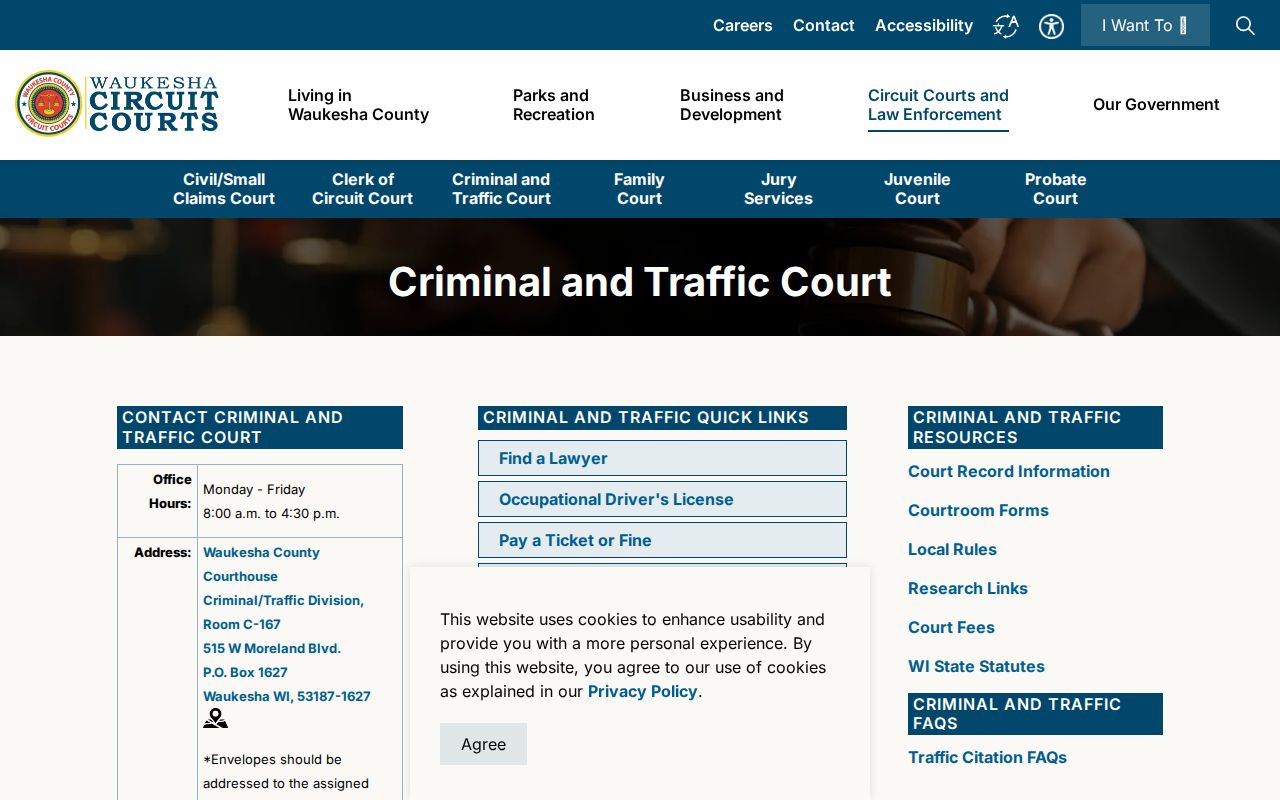
Room C-167 is the shared route for a copy request, a missing online document, or help identifying the correct branch.
Waukesha County Case Record Searches
Wisconsin Circuit Court Access, also known as WCCA or CCAP, is the free online index for a Waukesha County court case lookup. Accept the terms first. Search by party name and narrow the result to Waukesha County, or use a known case number. A birth date can help separate similar names. Read the case type before opening a result because a person may have criminal, traffic, civil, and family entries in the same public system.
- Open WCCA, accept its terms, and choose Waukesha County.
- Enter the last name and first name, adding a known birth date when needed.
- Use a case number instead when available, such as the year, CF code, and sequence.
- Open the matching docket and review counts, events, plea, disposition, sentence, and money entries.
- Contact Room C-167 for the filed complaint, judgment, certification, or document not offered online.
| Field label | Type | Required | Notes |
|---|---|---|---|
| County | Dropdown | No | Select Waukesha to localize the result. |
| Last name | Text | Name route | Try known spelling variations. |
| First and middle name | Text | No | Useful for narrowing a common surname. |
| Birth date | Date or text | No | Use only a known date. |
| Case number | Text | Alternate route | Full form resembles YYYYCF######; shorter forms may work with county selected. |
Waukesha County Court Records Offline
WCCA is a summary index, not the official filed document. Anonymous users cannot download every case image. The Waukesha County Clerk supplies copies at Room C-167, by mail, or through a courthouse public terminal. Staff need the case number. For certain searches, the last name, first name, and date of birth can substitute. Waukesha County has a longstanding practice of not emailing court records, and filings are not accepted through a routine inquiry email.
A mail request should identify the case number or party name and birth date, name the exact document, include a self-addressed stamped envelope, and provide a reachable phone number. Full payment is required before processing. Copy charges are $1.25 per page. Certification adds $5 per document, while a clerk-assisted search costs $5 when the requester cannot supply the required details. Credit cards are accepted in person or by phone.
Note: The WCCA docket identifies the document, but only the Waukesha County clerk can provide the official filed copy or certification.
What a Criminal Case File Contains
A Waukesha County criminal case file begins with the caption, case number, court, parties, type, filing date, and status. The complaint states the charged allegations. A felony file may later include an information after preliminary proceedings. Each count lists the offense description, statute, severity, offense date, plea, and disposition. The docket dates filings, hearings, bond action, motions, judgment, sentencing, warrants, and notices.
| Case number and court | County, case type, filing year, branch, status, and caption. |
|---|---|
| Charging document | The complaint and, in a felony case, a possible later information. |
| Docket entries | Dated filings and events such as bond, motions, plea, judgment, and warrant activity. |
| Hearing dates | Date, time, courtroom, event type, and responsible official when public. |
| Disposition and judgment | The result for each count, which may differ across one case. |
| Sentence and conditions | Confinement, probation, extended supervision, financial terms, and docketed conditions. |
Protected identifiers are omitted. Juvenile, confidential, sealed, and other restricted files do not appear like an ordinary public Waukesha County case.
Read Waukesha County Court Outcomes
Plea, disposition, and sentence answer different questions. A plea is the response to a charge. The disposition is the result, such as a dismissal, acquittal, or conviction. Sentence is the court-ordered consequence after conviction. When several counts appear, one may be dismissed while another results in conviction. Reading only the complaint or the first docket entry can leave an obsolete allegation in view.
- Initial appearance
- The first hearing addressing the charge, counsel, custody, and bail.
- Arraignment
- The hearing at which the charge is addressed and a plea is entered.
- Disposition
- The outcome of one count or the whole case.
- No contest
- A plea that permits conviction without an express factual admission.
- Extended supervision
- The community portion of a bifurcated Wisconsin prison sentence.
A current Waukesha County court case may have no final outcome yet. Check the latest dated event and status rather than inferring a result from an old count.
Criminal Case Stages in Waukesha County
Criminal procedure moves from the prosecutor's filing to a final outcome. Commissioners initially handle misdemeanor, criminal-traffic, traffic, and nontraffic forfeiture appearances or arraignments. A not-guilty nonfelony matter is placed on a trial calendar within 30 days. A guilty or no-contest criminal matter reaches the assigned judge within 30 days.
Case flow: Charges Filed › Arraignment › Pretrial › Plea or Trial › Disposition › Sentencing
The Waukesha County Criminal/Traffic rules set the local timing. For a felony, the preliminary examination is set within 10 days of the initial appearance when the defendant is in custody and 20 days when not in custody, unless time is waived. With a waiver, the general target is within 30 days. After bindover, the information and arraignment should occur promptly or within 30 days. Written pretrial motions are ordinarily due within 60 days after arraignment.
Waukesha County Court Archive Retrieval
An older Waukesha County criminal court file may be stored off site. Waukesha County's court record information page says ordinary retrieval usually takes up to 72 hours and has no retrieval surcharge. Once returned, the file is held for three business days. An emergency retrieval may take about two hours and costs $22.75 per trip. These are retrieval terms, not a promise that every restricted document becomes public.
Plan the courthouse visit around the file's arrival and the public counter schedule. General office hours are 8:00 a.m. to 4:30 p.m. on weekdays, excluding holidays. Construction and entrance conditions can change during the continuing courthouse modernization, so check current Waukesha County directions before travel. Courthouse visitors pass through controlled-access screening.
Note: Call Criminal/Traffic at 262-548-7484 before traveling for an archived file so staff can confirm its availability and hold period.
Waukesha County Expunged Court Cases
Wisconsin adult expungement under Wis. Stat. §973.015 seals a qualifying court record after successful completion when the judge ordered relief at sentencing. It does not vacate the conviction. It also does not automatically erase an arresting agency's report, the prosecutor's material, or Wisconsin DOJ CCH. A missing WCCA entry therefore does not prove that every related Waukesha County criminal record has disappeared.
Form CR-266 applies to an adult conviction with no probation or incarceration. It asks for the county, defendant, birth date, case number, proof that expungement was ordered, completion of the sentence and financial obligations, and confirmation of no intervening conviction. Probation cases use DOC-2678 discharge or satisfaction certification.
The official Wisconsin CR-266 form page is the source shown below.
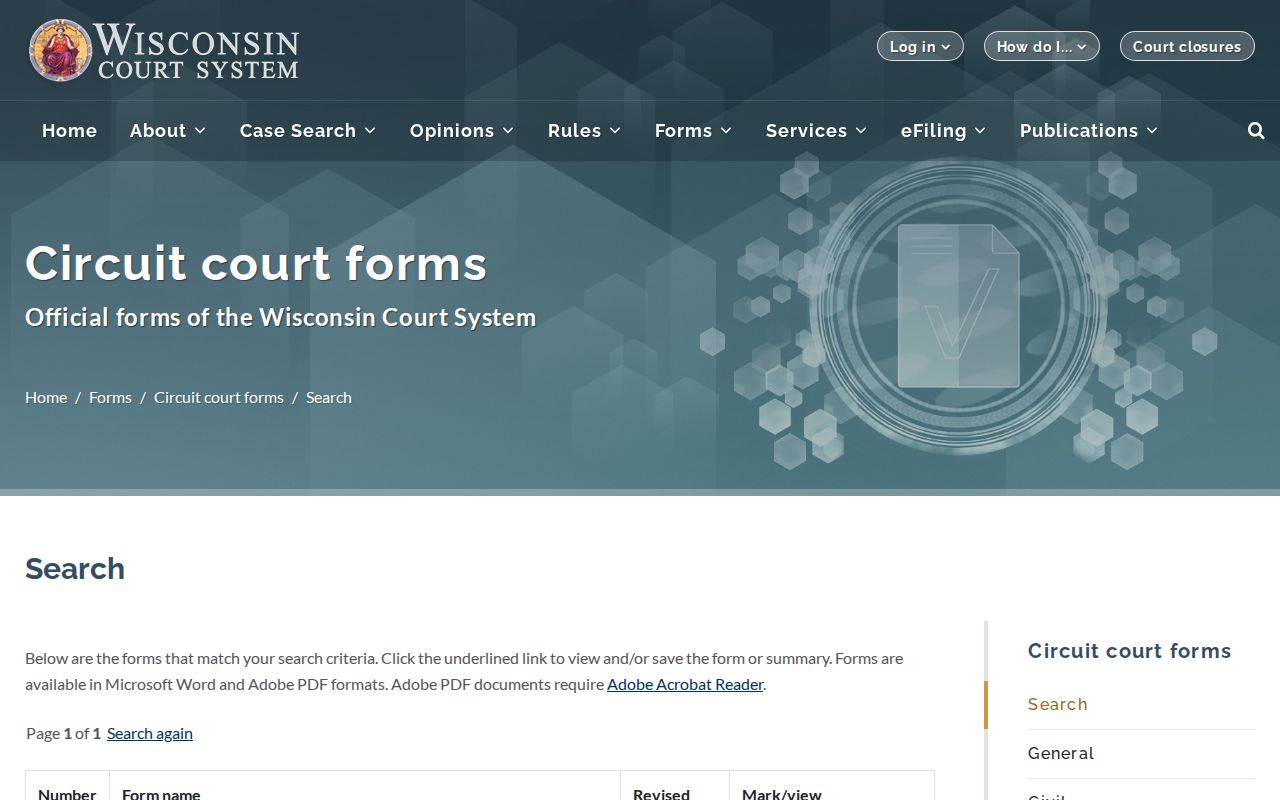
The form route applies only when the sentencing record and completion facts fit its requirements.
Access Rules for Case Records
Wisconsin Public Records Law favors access, but Waukesha County court cases remain subject to court-specific limits. Wis. Stat. §801.19 protects Social Security numbers, tax and employer identification numbers, financial account numbers, driver or state ID numbers, and passport numbers in filed documents. Juvenile, confidential, and sealed cases have separate restrictions. An online view may also be thinner than the paper file even when the case itself is public.
If a known case does not appear, verify spelling, birth date, county, and case type. Then ask the clerk whether the matter is municipal, archived, restricted, sealed, or filed under another name. Police reports remain with the arresting agency, not the court file. For that separate source, route a Sheriff event to Sheriff Records and a city event to the appropriate police department. The broader Waukesha County criminal history overview explains how those custodians fit together.
Remote proceedings remain court proceedings. Unauthorized recording is prohibited, and defendants generally must attend unless appearance by counsel is filed and approved. Missing evidentiary hearings, pleas, trials, or jury-status dates requires express approval. Interpreter requests use Wisconsin form GF-149 early enough for scheduling.