
Waukesha Criminal History Checks
Start with the Waukesha office that made the record. The City of Waukesha Police Department is the custodian for its incident, arrest, crash, dispatch, and related evidence records. Waukesha Municipal Court holds city ordinance, parking, and traffic-forfeiture matters. State misdemeanors and felonies take a different route through the District Attorney and Waukesha County Circuit Court. A person can appear in one Waukesha source and not another because each source describes a different stage.
Use a date, location, involved name, and incident or case number when known. These details help the records staff distinguish similar events. The official search sequence is:
- Call Waukesha Police at 262-524-3831 to identify the report custodian and ask how to submit the request.
- Describe each medium sought, such as the incident report, CAD entry, dispatch audio, video, photographs, or lockup record.
- Use Waukesha Municipal Court for a city ordinance, parking, or traffic matter.
- Check the county inmate list for current placement and WCCA for a state case filed by the prosecutor.
- Use Wisconsin DOJ records when a statewide criminal-history record is needed, while remembering that it has a different scope.
Waukesha Dispatch Record Deadlines
Timing can determine whether a Waukesha police record still exists. Waukesha retention material says dispatch phone and radio traffic is recorded continuously and kept for at least 120 days. Waukesha municipal lockup and Opti-cop surveillance material follows a creation-plus-121-day period. By contrast, Waukesha incident, case, and offense reports remain for the event plus seven years. A written report may therefore survive long after sound or video tied to the same event is gone.
Ask for the specific Waukesha medium as soon as possible. A request labeled only “police report” may not collect 911 audio, radio traffic, body-camera video, photographs, or lockup footage. Give the Waukesha event date, approximate time and location, and incident number if known. Waukesha can review each item separately, so the fact that a narrative can be released does not mean all video or audio will be released without redaction.
Note: A short retention period makes prompt, precise requests especially important for Waukesha dispatch and temporary-lockup evidence.
Records at Waukesha Police Department
Waukesha Police creates the first local record for a Waukesha call, investigation, citation, or arrest. The Waukesha department’s published directives and annual reports give policy and activity context, while the records channel supplies event-level material that is legally releasable. Waukesha police records can include incident narratives, officer actions, dispatch entries, crash records, citations, photographs, and other evidence. The exact Waukesha file depends on what happened and which unit handled it.
Release is not all or nothing. Juvenile information, victim details, protected health data, active investigative material, and other confidential content may be withheld or redacted. Body-camera images can require separate review even when the written narrative is open. Waukesha Police, not the county sheriff, decides access to records that its officers created. The county Sheriff Records Division cannot supply a City of Waukesha report just because later custody occurred at the county jail.
The Waukesha department’s 2024 activity also shows why record labels matter: calls, officer activity, incidents, citations, arrests, and reported offenses are counted in different ways. None should be read as a count of Waukesha convictions.
Reading Waukesha Police Records
The 2024 Waukesha police annual report recorded 49,864 CAD entries, including 21,300 calls for service and 25,899 self-initiated calls. It also reported 4,865 Waukesha incident reports, 1,509 crashes, 1,186 nontraffic citations, 9,267 traffic citations, 2,950 adult arrests, and 338 juvenile arrests. These Waukesha categories overlap in ways that make a quick total misleading. One call can produce an incident report, several alleged offenses, an arrest, and more than one citation.
NIBRS figures are police-reported offense categories, not court judgments. Waukesha reported 364 assaults, 608 thefts, 739 drug or narcotics offenses, and other categories during that year. A case-specific records check must still trace the event to the District Attorney’s decision and the Circuit Court disposition. An arrest count cannot show whether a charge was declined, changed, dismissed, diverted, or proved in court.
Booking and Arrest Records in Waukesha
A Waukesha custodial arrest starts with the Waukesha Police report and may use Waukesha’s temporary municipal lockup. Continued adult custody then moves to Waukesha County Jail. The jail creates its own intake, fingerprint, photograph, property, placement, bond, and release records. Those booking records are separate from the Waukesha narrative and from any court file that comes later.
The county’s hourly inmate list is useful but narrow. It shows only a person’s name and placement as County Jail or electronic monitoring. It does not identify Waukesha Police as the arresting agency, show charges, provide a booking number, list bond, or display a photograph. Call the jail at 262-548-7170 when current placement needs confirmation. If a name is absent, the person may have been released, transferred, never admitted, or not yet reflected.
After a District Attorney filing, WCCA may show a Waukesha County CF, CM, or CT case. Charging may lag behind custody. The broader Waukesha County arrest search explains those county access routes in more depth.
Waukesha Special-Unit Evidence Records
Some Waukesha events create evidence outside a basic incident narrative. The 2024 report describes two Internet Crimes Against Children detectives, a Narcotics and Vice unit with 171 controlled buys, three K9 teams with 175 deployments, seven drug-recognition experts, and a Major Crash Task Force used three times. Each Waukesha activity can produce a distinct set of records, such as digital evidence logs, controlled-buy documentation, canine deployment reports, evaluation reports, or crash reconstruction material.
Ask which Waukesha unit led the event. Multi-agency work may leave the primary Waukesha file with a different custodian than expected. The county Criminal Justice Collaborating Council describes local Drug and OWI Treatment Courts that can become relevant after a case reaches court.
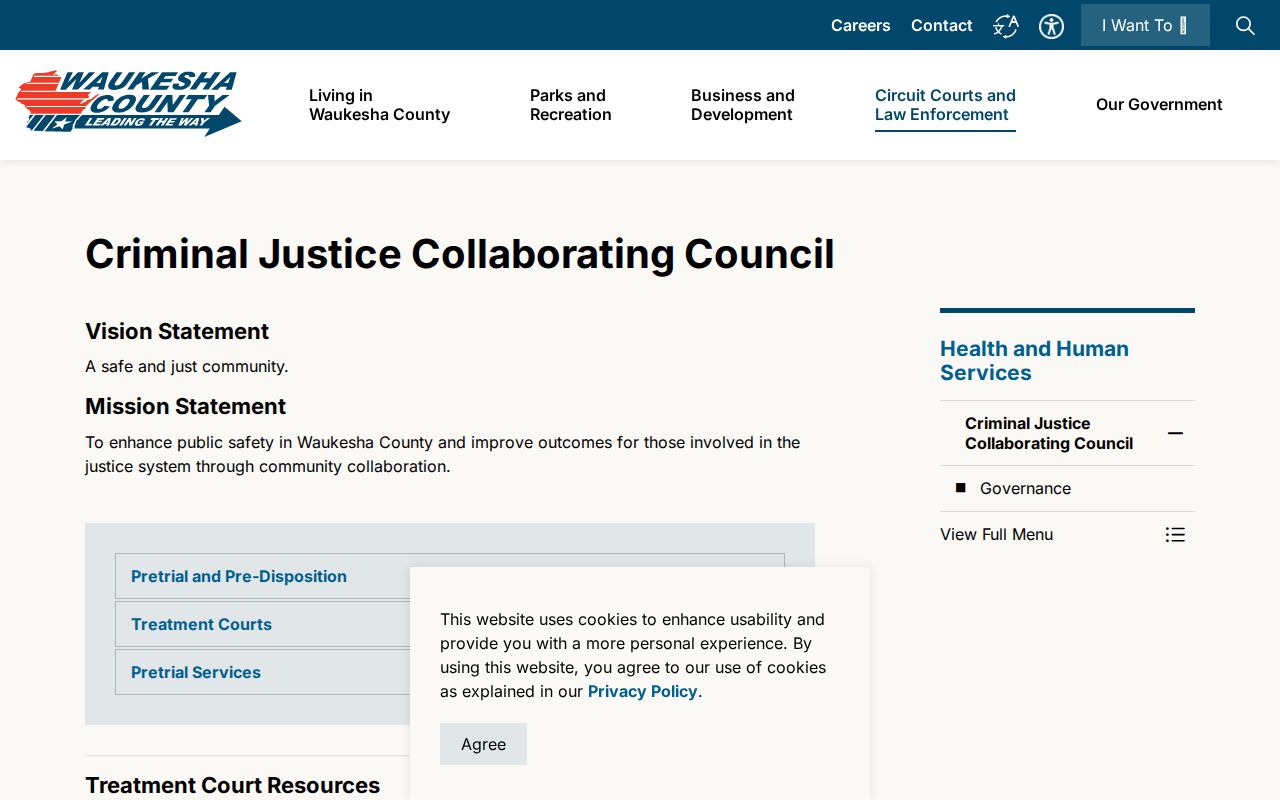
That court-program view shows why an enforcement record and a later treatment-court record answer different questions about the same person’s case path.
The Waukesha Municipal Court File
Waukesha Municipal Court handles noncriminal city ordinance, parking, and traffic matters. It does not hear Wisconsin felony or misdemeanor prosecutions. A local citation may lead to a forfeiture, which is a monetary penalty for an ordinance violation, without creating a county criminal conviction. Searchers lose time when they treat the municipal and Circuit Court layers as one docket.
| Court Name | City of Waukesha Municipal Court |
|---|---|
| Case Types Heard | City ordinance, parking, and traffic-forfeiture matters |
| Case Lookup Channel | Municipal court phone, counter, and city system |
| What the File Shows | Citation, local court events, plea or decision, forfeiture, and payment information when maintained |
| State Criminal Cases | Filed with Waukesha County Circuit Court and summarized through WCCA |
A police-issued citation is not automatically a misdemeanor. Conversely, a police referral may produce a Circuit Court criminal case even when the municipal court has no related file. Check the issuing authority on the citation before choosing the court.
Waukesha Citation and Criminal Records
The Waukesha city-versus-county split becomes clear at the charging stage. Waukesha Police may issue a municipal citation that remains in Waukesha Municipal Court. For suspected state crimes, police refer the matter to the Waukesha County District Attorney. The prosecutor may decline it, use a diversion route when supported, change the proposed charge, or file a criminal complaint. Only a filing opens the county Circuit Court case.
Wisconsin Circuit Court Access, or WCCA, then supplies a public summary with the case number, type, status, counts, statutes, docket events, hearings, disposition, sentence, and financial information that is open to public inspection. The official filed documents remain with the Clerk. Read the plea, disposition, and sentence as distinct entries. An allegation is not an outcome, and a dismissal does not erase the separate Waukesha Police report.
How Waukesha Records Reach the County
A city arrest may generate several records in sequence. Waukesha Police keeps the incident and arrest narrative. County Jail creates the custody file after admission. The District Attorney decides whether to file a state case, and the Clerk maintains that Circuit Court file. Fingerprint-supported arrest and disposition events can then reach the Wisconsin Department of Justice Crime Information Bureau.
Record flow: Waukesha Police Department › Waukesha County Jail and Circuit Court › Wisconsin DOJ Crime Information Bureau
Each Waukesha record stop has its own purpose. Recent Waukesha facts are often best found with city police or the jail, while a later court outcome belongs in WCCA and the Clerk’s file. A DOJ name check is statewide but is not identity-confirmed. Countywide options are summarized in the Waukesha County criminal history overview.
Note: Absence from one system does not prove that no Waukesha event or record exists in another official channel.
When Waukesha Booking Records Vanish
A blank Waukesha result in the hourly inmate PDF answers one narrow question: the name is not shown in the current public placement list at that moment. It does not establish that Waukesha Police made no arrest. The person may have left Waukesha custody, moved to a state facility, entered electronic monitoring under a different placement, or never reached county jail. Spelling also matters.
Call the county jail for current custody, then request the Waukesha Police report for the source event. Check WCCA after allowing for the prosecutor’s filing decision. For an older Waukesha booking, ask the jail or Sheriff Records about a releasable custody record. This sequence preserves the Waukesha altitude because the police report remains the source for the Waukesha event, while the county systems answer only custody and prosecution questions.
Waukesha Criminal Record Retention
Waukesha’s published retention periods help set realistic expectations. Incident, case, and offense reports follow the event plus seven years. Public-record request files follow the event plus three years. Mugshots are listed as permanent records, while municipal lockup and Opti-cop surveillance material uses the much shorter creation-plus-121-day period. A later court expungement does not automatically erase police, prosecutor, or DOJ records.
Retention does not equal public release. A Waukesha record may still exist but be withheld in whole or part because of a juvenile matter, active investigation, victim safety, privacy interests, or another legal restriction. Ask the Waukesha custodian for the specific record and date range. If access is denied, a written explanation helps identify whether the issue is retention, confidentiality, or the public-records balancing test.
Waukesha Record Access Rules
Wisconsin Public Records Law starts with a presumption of access, subject to statutes, common-law exceptions, and a custodian’s balancing of public interests. Waukesha Police applies that rule to city-created records. Courts apply separate access rules to filed cases, and DOJ law governs the statewide criminal-history repository. Protected identifiers and confidential case types do not become public merely because another part of a file can be inspected.
Key Statutes:
Wisconsin Public Records Law, Wis. Stat. §§19.31–19.39 creates the access presumption and recognizes lawful limits.
Wis. Stat. §165.83 establishes DOJ criminal-identification and reporting functions.
Wis. Stat. §801.19 protects specified personal identifiers in public court filings.
Requesters should verify a Waukesha record with its originating office. Police narratives, jail placements, municipal findings, Circuit Court dispositions, and DOJ histories describe different parts of the process.